
This is an open-access article distributed under the terms of the Creative Commons Attribution Non-Commercial License (http://creativecommons.org/licenses/by-nc/3.0/) which permits unrestricted noncommercial use, distribution, and reproduction in any medium, provided the original work is properly cited.
Sarcopenia is associated with metabolic disorders, cardiovascular disease, and mortality; however, its association with depression in the general population remains unknown. Therefore, we investigated this association in Korea.
Methods
This study included 8,958 and 8,518 subjects from the 2010–2011 Korean National Health and Nutrition Examination Survey V-1, 2. The study was restricted to participants ≥20 years of age who had completed the survey, including whole-body dual-energy X-ray absorptiometry scans. After exclusion, 7,364 subjects were included in our final analysis. Age was categorized into three groups (20–39, 40–59, and ≥60 years), and subjects were categorized according to their sarcopenic and obesity status. Depression was categorized into three groups (not depressed, depressed, and depression).
Results
The sarcopenia group did not have a higher prevalence of depression or depressive symptoms compared to the nonsarcopenia group; the same was true even when obesity was considered. All age groups showed non-significant associations between sarcopenia and depression. In multivariate logistic regression models, no significant associations were observed between sarcopenia and prevalence of depression or depressed symptoms in men and women.
Conclusion
We found no associations between sarcopenia and the prevalence of depression or depressed symptoms in Korean adults. Future large prospective studies and randomized controlled trials are needed to further assess this relationship.
Depression is a mood disorder with symptoms that include persistently depressive mood, loss of motivation or interest, and feelings of guilt. Severe cases may be accompanied by eating and memory disorders, and may also lead to suicide.1) The data from the 2005–2008 National Health and Nutrition Examination Survey conducted in the United States reported that approximately 21.6% of participants showed depressive symptoms,2) whereas the World Health Organization World Mental Health (2004) Surveys reported lifetime prevalences of major depressive disorders of 19.2%, 21.0%, and 17.9% for the United States, France, and the Netherlands, respectively.3) Based on the 2011 Epidemiological Survey of Mental Disorders in Korea from the Ministry of Health and Welfare, 6.7% of participants 18 years and older experienced major depressive disorders at least once in their lifetimes.4) The prevalence of major depressive disorders in Korea is lower than that reported in other countries. This observation is interpreted as a sociocultural difference, in that Far East Asian cultures do not satisfy the diagnostic criteria for major depressive disorders: assessments often reveal no major symptoms because the individuals themselves consider depressive symptoms to be mild conditions.5)
In 1988, Rosenberg6) first proposed the term 'sarcopenia.' Sarcopenia is an aging-associated condition defined as the loss of muscle strength due to loss of muscle mass. The diagnostic criteria for sarcopenia were presented by Baumgartner et al.7) in the 1998 New Mexico Elder Health Survey, but there is currently no generally accepted diagnostic method for sarcopenia. Studies on sarcopenia have made comparisons to osteoporosis, another typical physical change in the elderly, but studies of osteoporosis are lacking.8) Janssen et al.9) reported that the social cost associated with sarcopenia in the United States reached $18.5 billion in 2000, and noted the need for measures to address sarcopenia. The need for studies on and measures for sarcopenia is apparent in Korea as well, as it becomes an increasingly aging society.
Sarcopenia is associated with physical inactivity, disability, diabetes, metabolic syndrome, cardiovascular diseases, and mortality.1011) Since depression is also linked to physical inactivity or dysfunction,12) there may be an association between sarcopenia and depression. The relationship between depression and obesity is well known. Meta-analyses have also the high probability that obesity accompanies and may be a risk factor for depression.13) In a study on sarcopenic obesity and mental health, Cho et al.14) also reported that sarcopenic obesity was associated with anxiety and depressive symptoms. Therefore, we speculated that sarcopenia and sarcopenic obesity would be associated with depression.
While recent studies have evaluated the association between sarcopenia and physical symptoms and diseases, studies on the association with mental health, including depression, are lacking. Although Kim et al.15) and Hsu et al.16) demonstrated that sarcopenia is associated with depression, additional studies are needed.
Studies on sarcopenia and depression to this point have been insufficient and few have included younger age groups. Therefore, the present study used data from the 2010–2011 Korean National Health and Nutrition Examination Survey (KNHANES V-1, 2) to examine the relationship between sarcopenia and depression in the Korean population by age group and obesity status.
METHODS
1. Study Population
The KNHANES is conducted annually using a systematic sampling method after stratifying for population ratios based on the town units of dong, eup, and myun, as well as housing type and age group. The survey participants include household members at least one year of age from approximately 3,800 households nationwide. The first year of the fifth survey was conducted between January and December 2010; the second year continued from January to December 2011.17) The present study used data from 2010 and 2011; the most recent data that also included dual energy X-ray absorptiometry (DEXA). The present study included only those participants 20 years or older who had completed both the DEXA and the questionnaire. Participants with physician-diagnosed diseases that could also affect depression, such as cancer, liver cirrhosis, kidney failure, or cerebro- or cardiovascular diseases, were also excluded. The total study population was 7,364 individuals, comprised 5,245 and 2,119 people from 2010 and 2011, respectively, after excluding 1,420 and 4,381 of 6,665 and 6,500 adults for missing values. The present study used data from the KNHANES-V, which received institutional review board approval (2010–02CON-21-C, 2011-02CON-06-C).
2. Measurement
1) Depressed state
As described previously,18) patients were classified as having depression, depressed symptoms, or not depressed. The depression group comprised respondents who indicated that they had been clinically diagnosed with depression. Among those who had not been clinically diagnosed as having depression, those who responded "yes" to the question "In the past year, have you felt sadness or despair continuously for two or more weeks that was severe enough to interfere with daily life?" were assigned to the depressed symptom group. Similarly, those who were not clinically diagnosed as having depression and who also did not report having experienced depressive symptoms for 2 weeks or more in the past year were categorized as not depressed.
2) Obesity and sarcopenia
Obesity was diagnosed using body mass index (BMI), with BMI ≥25 defined as obese when height (Ht) and weight (Wt) were substituted into the equation, BMI=Wt/Ht2.
Sarcopenia was diagnosed using a modified version of a method described in a previous study.19) After measuring participant appendicular skeletal muscle mass (ASM) via DEXA, the ASM/Wt (%) values were calculated; participants with values two standard deviations below the mean of the younger age group were classified as having sarcopenia.20) The mean ASM/Wt (%) of participants 20–39 years of age, 26.88% for men and 21.02% for women, were used as the cut-off points. Depending on their sarcopenia and obesity status, the study participants were divided into sarcopenic obese, nonsarcopenic obese, sarcopenic nonobese, and nonsarcopenic nonobese groups.
3) Metabolic syndrome
Metabolic syndrome was diagnosed using the modified adult treatment panel III presented in 2005 by the American Heart Association and National Heart, Lung, and Blood Institute.21) Patients satisfying three or more of the five criteria listed below were considered to have metabolic syndrome: (1) waist size ≥90 cm for men and ≥85 cm for women;22) (2) triglyceride levels over 150 mg/dL or under treatment for hyperlipidemia; (3) blood pressure (BP) ≥130/85 mm Hg or under treatment for hypertension; (4) high density lipoprotein cholesterol levels (HDLC) <40 mg/dL for men and <50 mg/dL for women; and (5) fasting blood glucose levels over 100 mg/dL or under treatment for diabetes.
Serum triglyceride, HDLC, and fasting blood glucose levels were measured via an enzymatic method using a Hitachi Automatic Analyzer 7600 (Hitachi, Tokyo, Japan).
3. Statistical Analysis
Because the number of subjects in the KNHANES varies from year to year, integrated weighted values were used for the analysis. Chi-square tests and analysis of variance were used to determine if the presence of sarcopenia was significantly associated with differences in depressed state. Stratified analysis was used to examine the association between sarcopenia and depression by age groups, while multiple logistic regression analysis was adjusted for covariates and performed to determine the relationship between sarcopenia and depression by gender. Gender, age, BMI, smoking, metabolic syndrome, diabetes, hypertension, and menopause (in women) were used as covariates. The statistical significance was set to <0.05. Categorical and continuous data were expressed as frequencies and means±standard error. IBM SPSS Statistics for Windows ver. 22.0 (IBM Co., Armonk, NY, USA) was used for all statistical processing.
RESULTS
1. Clinical Characteristics of the Study Population
The mean ages in the sarcopenia and nonsarcopenia groups were 54.71 and 44.24 years, respectively, indicating a higher mean age among participants in the sarcopenia group. The sarcopenia group had higher total cholesterol, triglyceride, and low density lipoprotein cholesterol (LDLC) levels, but lower HDLC than the nonsarcopenia group. The prevalence of metabolic syndrome in the sarcopenia and nonsarcopenia groups was 58.7% and 25.3%, respectively. However, the difference in the prevalence of depressive symptoms and depression with sarcopenia between these groups was not statistically significant (Table 1).
2. Depression by Sarcopenia and Obesity Status
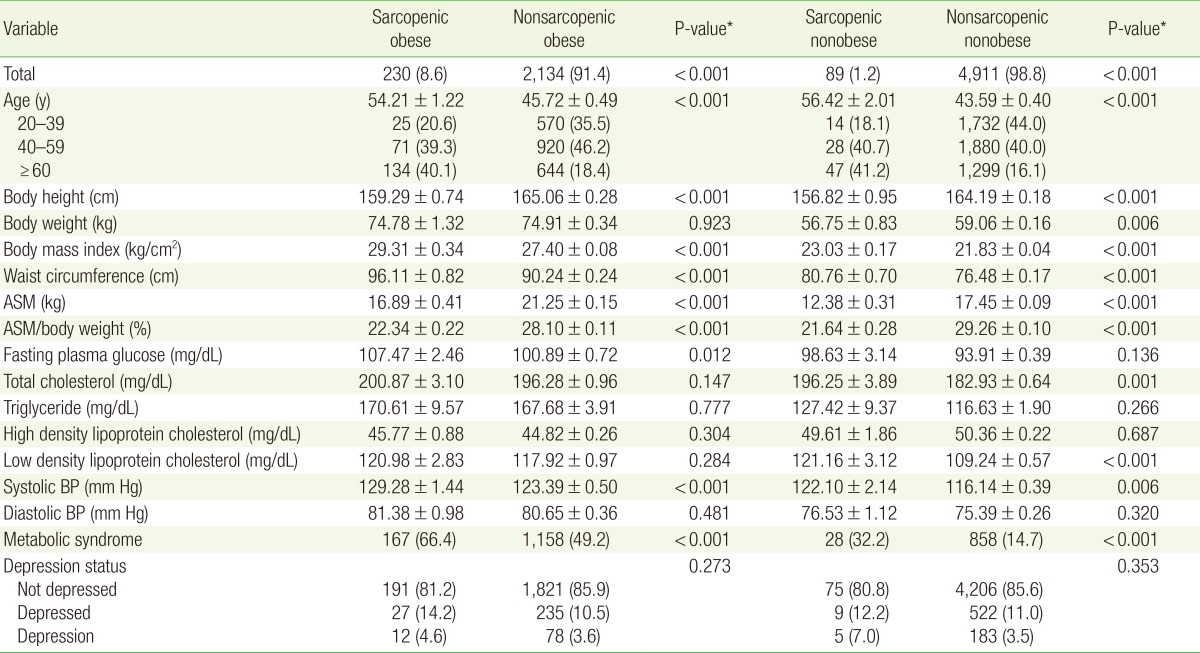
The prevalence of sarcopenia in the obese and nonobese groups was 8.6% and 1.2%, respectively. Participants with sarcopenia who were also obese had higher systolic BP and prevalence of metabolic syndrome than the nonsarcopenic obese group. Meanwhile, the sarcopenic nonobese group showed higher levels of total cholesterol, LDLC, systolic BP, and prevalence of metabolic syndrome than the nonsarcopenic nonobese group; these findings suggest that, regardless of obesity status, sarcopenia was associated with higher systolic BP and prevalence of metabolic syndrome. Within the sarcopenic obese group, 14.2% had depressed symptoms, and 4.6% were depressed, compared to 10.5% and 3.6%, respectively, in the nonsarcopenic obese group. These results demonstrate that depressed symptoms and depression were higher in obese participants when accompanied by sarcopenia; however, these findings were not statistically significant. Similarly, depressive symptoms and prevalence of depression were higher in the sarcopenic nonobese group than in the nonsarcopenic nonobese group, again without statistical significance (Table 2).
3. Sarcopenia and Depression by Age Group
Stratified analysis was performed by age group after dividing the study population into four groups by sarcopenia and obesity status. Sarcopenia was not associated with depressive symptoms or prevalence of depression in any age group (20–39, 40–59, and ≥60 years) (Table 3).
4. Depression according to Sarcopenia Status
Multiple logistic regression analysis showed no association between sarcopenia and depression before and after adjusting for covariates. Moreover, sarcopenia was not associated with depression in either men or women (Table 4).
DISCUSSION
The present study used KNHANES V-1, 2 data to investigate the association between sarcopenia and depression. Although the sarcopenia group showed higher depressive symptoms and prevalence of depression than the nonsarcopenia group, the findings were not statistically significant. Sarcopenia was not associated with depression even in analyses that considered obesity status, age, and gender.
This study had several limitations. First, subjective judgment may influence the depression-related survey process. Koreans have a tendency to respond negatively to mental health-related questions. This tendency can lead to underestimation of the prevalence of depressive symptoms and depression, which may limit the informativeness of statistical testing. Second, classification errors are also possible since survey questions, rather than a specialized depression assessment tool, were used for classification. The relationship between two factors, therefore, might be underestimated due to the influence of non-discriminatory classification errors.
Previous studies have mostly reported associations between sarcopenia and depression in elderly men. Lee et al.23) reported that a decrease in skeletal muscles was associated with depressive symptoms in elderly Chinese men, while Kim et al.15) reported that sarcopenia was associated with depression in elderly Korean men. A study by Hsu et al.16) also reported sarcopenia to be associated with depression in Taiwanese veterans.
Although the mechanism of association between sarcopenia and depression has not been clearly identified, many factors have been suggested. Chronic low-level inflammation,2425) excessive oxidative stress,2627) and testosterone2829) may be predictive factors for these diseases.
Unlike previous studies, the findings in the present study showed no association between sarcopenia and depression. While sarcopenia and depression share common factors, they have a weak influence on the association between these diseases. The typical physical changes in the elderly involve body composition changes, including increased body fat mass and weakening of the musculoskeletal system. The association between obesity, which is characteristic of body fat mass increase, and depression has been reported; however, the association between sarcopenia and depression remains inconsistent. Therefore, while the pathophysiology of depression is likely associated with an increase in body fat mass and adipose tissues, its association with a skeletal muscle decrease requires additional study. The scarcity of other studies on this topic, therefore, make the findings of the present study important for determining the criteria for associations between sarcopenia and other diseases.
The present study has several limitations. First, muscle strength or function was not considered when diagnosing sarcopenia. The diagnosis of sarcopenia based only on decreased skeletal muscle mass used in the present study may have resulted in errors in identifying participants with sarcopenia. Second, the cross-sectional nature of this study limited its ability to prove a causal relationship between sarcopenia and depression. Therefore, future longitudinal studies, including large-scale cohort studies, are necessary. Third, the use of a subjective questionnaire rather than a depression assessment tool to define the depressed state in this study could have led to underestimation and classification errors.
Despite these limitations, the present study is significant from the perspective that it used nationally representative data from KNHANES-V. The fact that the findings were contrary to previous studies is also meaningful. Future large-scale cohort studies on the association between sarcopenia and depression, as well as studies on the pathophysiology of sarcopenia, are necessary.
Notes
CONFLICT OF INTEREST: No potential conflict of interest relevant to this article was reported.
References
1. Peveler R, Carson A, Rodin G. Depression in medical patients. BMJ 2002;325:149-152. PMID: 12130614.
2. Shim RS, Baltrus P, Ye J, Rust G. Prevalence, treatment, and control of depressive symptoms in the United States: results from the National Health and Nutrition Examination Survey (NHANES), 2005-2008. J Am Board Fam Med 2011;24:33-38. PMID: 21209342.
3. Bromet E, Andrade LH, Hwang I, Sampson NA, Alonso J, de Girolamo G, et al. Cross-national epidemiology of DSM-IV major depressive episode. BMC Med 2011;9:90PMID: 21791035.
4. Seoul National University College of Medicine. The epidemiological survey of mental disorders in Korea 2011. Sejong: Ministry of Health and Welfare; 2012.
5. Chang SM, Hahm BJ, Lee JY, Shin MS, Jeon HJ, Hong JP, et al. Cross-national difference in the prevalence of depression caused by the diagnostic threshold. J Affect Disord 2008;106:159-167. PMID: 17725930.
7. Baumgartner RN, Koehler KM, Gallagher D, Romero L, Heymsfield SB, Ross RR, et al. Epidemiology of sarcopenia among the elderly in New Mexico. Am J Epidemiol 1998;147:755-763. PMID: 9554417.
9. Janssen I, Shepard DS, Katzmarzyk PT, Roubenoff R. The healthcare costs of sarcopenia in the United States. J Am Geriatr Soc 2004;52:80-85. PMID: 14687319.
10. Janssen I, Heymsfield SB, Ross R. Low relative skeletal muscle mass (sarcopenia) in older persons is associated with functional impairment and physical disability. J Am Geriatr Soc 2002;50:889-896. PMID: 12028177.
12. Cole MG, Dendukuri N. Risk factors for depression among elderly community subjects: a systematic review and meta-analysis. Am J Psychiatry 2003;160:1147-1156. PMID: 12777274.
13. Luppino FS, de Wit LM, Bouvy PF, Stijnen T, Cuijpers P, Penninx BW, et al. Overweight, obesity, and depression: a systematic review and metaanalysis of longitudinal studies. Arch Gen Psychiatry 2010;67:220-229. PMID: 20194822.
14. Cho Y, Shin SY, Shin MJ. Sarcopenic obesity is associated with lower indicators of psychological health and quality of life in Koreans. Nutr Res 2015;35:384-392. PMID: 25931418.
15. Kim NH, Kim HS, Eun CR, Seo JA, Cho HJ, Kim SG, et al. Depression is associated with sarcopenia, not central obesity, in elderly korean men. J Am Geriatr Soc 2011;59:2062-2068. PMID: 22092258.
16. Hsu YH, Liang CK, Chou MY, Liao MC, Lin YT, Chen LK, et al. Association of cognitive impairment, depressive symptoms and sarcopenia among healthy older men in the veterans retirement community in southern Taiwan: a cross-sectional study. Geriatr Gerontol Int 2014;14(Suppl 1):102-108. PMID: 24450567.
17. Korea Centers for Disease Control and Prevention. The fifth Korea National Health and Nutrition Examination Survey (KNHANES V-1, 2) 2010–2011. Cheongju: Korea Centers for Disease Control and Prevention; 2010-2011.
18. Koo S, Park K. Associations of serum 25(OH)D levels with depression and depressed condition in Korean adults: results from KNHANES 2008-2010. J Nutr Health 2014;47:113-123.
19. Muscaritoli M, Anker SD, Argiles J, Aversa Z, Bauer JM, Biolo G, et al. Consensus definition of sarcopenia, cachexia and pre-cachexia: joint document elaborated by Special Interest Groups (SIG) "cachexia-anorexia in chronic wasting diseases" and "nutrition in geriatrics". Clin Nutr 2010;29:154-159. PMID: 20060626.
20. Moon SS. Low skeletal muscle mass is associated with insulin resistance, diabetes, and metabolic syndrome in the Korean population: the Korea National Health and Nutrition Examination Survey (KNHANES) 2009-2010. Endocr J 2014;61:61-70. PMID: 24088600.
21. Grundy SM, Cleeman JI, Daniels SR, Donato KA, Eckel RH, Franklin BA, et al. Diagnosis and management of the metabolic syndrome: an American Heart Association/National Heart, Lung, and Blood Institute Scientific Statement. Circulation 2005;112:2735-2752. PMID: 16157765.
22. Lee SY, Park HS, Kim DJ, Han JH, Kim SM, Cho GJ, et al. Appropriate waist circumference cutoff points for central obesity in Korean adults. Diabetes Res Clin Pract 2007;75:72-80. PMID: 16735075.
23. Lee JS, Auyeung TW, Kwok T, Lau EM, Leung PC, Woo J. Associated factors and health impact of sarcopenia in older chinese men and women: a cross-sectional study. Gerontology 2007;53:404-410. PMID: 17700027.
25. Baune BT, Smith E, Reppermund S, Air T, Samaras K, Lux O, et al. Inflammatory biomarkers predict depressive, but not anxiety symptoms during aging: the prospective Sydney Memory and Aging Study. Psychoneuroendocrinology 2012;37:1521-1530. PMID: 22406002.
27. Bakunina N, Pariante CM, Zunszain PA. Immune mechanisms linked to depression via oxidative stress and neuroprogression. Immunology 2015 1 10 [Epub]. PMID: 10.1111/imm.12443.
*Calculated by analysis of variance and chi-square tests. †Smoking status was divided into three categories: never, former, and current smoker. ‡Regular exercise was defined as "yes" when the participant performed moderate or strenuous exercise on a regular basis (for more than 30 minutes at a time and more than five times per week in the case of moderate exercise; for more than 20 minutes at a time in the case of strenuous exercise) or when the subject walked for more than 30 minutes at a time and more than five times per week. Strenuous exercise included running, climbing, bike riding at fast speed, swimming at fast speed, football, basketball, jumping rope, squash, tennis of singles, and physical activities such as carrying heavy objects. Moderate exercise included swimming at slow speed, tennis of doubles, volleyball, badminton, ping-pong, and physical activities such as carrying light objects.
Table 2
Characteristics of the study population according to sarcopenia and obesity
Values are presented as mean±standard error of number (%).
*Calculated by analysis of variance and chi-square tests.
Table 3
Comparisons of depressive states and sarcopenia by age
Values are presented as number (%).
*Calculated by analysis of variance and chi-square test, and layered analysis.
Table 4
Adjusted ORs for sarcopenia
OR, odds ratio; CI, confidence interval; BMI, body mass index.
*Calculated by multiple regression analysis. †Total population and men were adjusted for sex, age, BMI, exercise, smoking, metabolic syndrome, diabetes mellitus, and hypertension. ‡Women were adjusted for sex, age, BMI, exercise, smoking, metabolic syndrome, diabetes mellitus, hypertension, and menopause.
Figure & Data
References
Citations
Citations to this article as recorded by
Association between sarcopenia components and depressed mood varies by sex among community-dwelling older adults from the Korean Frailty and Aging Cohort Study Yong Soon Park, Keunjoong Yoo, Hye Jin Kim, Miji Kim, Chang Won Won Scientific Reports.2025;[Epub] CrossRef
Bidirectional association between sarcopenia and depression: A systematic review and meta-analysis Xiangpeng Meng, Ze Wang, Linyu Lyu Archives of Gerontology and Geriatrics.2025; 132: 105787. CrossRef
Dietary influence on the link between depression and muscle mass and muscle strength: exploring interaction and mediation effects Da Gan, Xuebiao Wu, Yingjuan Zhang, Yue Gao, Xia Huang, Shuang Han BMC Public Health.2025;[Epub] CrossRef
Possible sarcopenia and depression among middle-aged and older adults in China: A 9-year longitudinal survey Xiang-yang He, Zheng Liu, Zhi-wei Lu, Ren-cheng Zhao, Yan-Fang Guo, Qing Yuan, Li Huang, Xing-lin Zhong, Sayani Das PLOS ONE.2025; 20(4): e0318666. CrossRef
The association between sarcopenic obesity and depression in middle-aged and elderly U.S. adults: insights from the NHANES study Xiaoming Zhang, Rui Zeng, Wenwu Zhang, Fayi Xie, Aizhang Zhu, Lihuan Chen, Ke Zhu, Tenghui Fan, Yishan Wu, Xu Luo, Yuxu Huang, Dongmei Ye, Jiahui Bian, Wan Zhu, Jiang Wang, Qingli Dou, Conghua Wang Aging Clinical and Experimental Research.2025;[Epub] CrossRef
Association between Sarcopenia-related traits and depression: an observational and Mendelian randomization analysis Shitu Zhuo, Biyue Zhang, Xinxia Yang European Archives of Psychiatry and Clinical Neuroscience.2025;[Epub] CrossRef
Analysis of Risk Factors for Coronary Heart Disease in Middle-Aged Men Using the Framingham Risk Score: Based on the Korea National Health and Nutrition Examination Survey (2014-2015) Yeong Jeon, Kyoung Yun Kim, Jung-Mi Yun Preventive Nutrition and Food Science.2025; 30(4): 295. CrossRef
Genetically Proxied Sarcopenia-Related Muscle Traits and Depression: Evidence from the FinnGen Cohort Zhengtao Lv, Yingchao Zhao, Jiarui Cui, Jiaming Zhang The American Journal of Geriatric Psychiatry.2024; 32(1): 32. CrossRef
Social network associated with depressed mood and sarcopenia among older adults in Taiwan Yu-Hung Lin, Der-Sheng Han, Yi-Hsuan Lee, Ding-Cheng Chan, Chia-Hsiu Chang, Kuen-Cheh Yang, Fong-Ching Chang Journal of the Formosan Medical Association.2024; 123(5): 620. CrossRef
Obesity paradox in older sarcopenic adults ― a delay in aging: A systematic review and meta-analysis Szimonetta Eitmann, Peter Matrai, Peter Hegyi, Marta Balasko, Balint Eross, Kira Dorogi, Erika Petervari Ageing Research Reviews.2024; 93: 102164. CrossRef
Association Between Sarcopenia, Insomnia, and Depression in Elderly Patients Hasan Öztin, Kazım Kıratlı The Anatolian Journal of General Medical Research.2024; : 28. CrossRef
Associations of muscle mass and strength with depression among US adults: A cross-sectional NHANES study Linjie Qiu, Yan Ren, Jixin Li, Meijie Li, Wenjie Li, Lingli Qin, Chunhui Ning, Jin Zhang, Feng Gao Journal of Affective Disorders.2024; 363: 373. CrossRef
Associations between sarcopenia and depression in middle-aged and older adults: the moderating effect of smoking Feiyun Zhu, Jing Guo, Weijun Zheng Scientific Reports.2024;[Epub] CrossRef
The prevalence of sarcopenia and risk factors in the older adult in China: a systematic review and meta-analysis Shilong Meng, Xiaomin He, Xinlei Fu, Xu Zhang, Minghao Tong, Wei Li, Wei Zhang, Xiaolin Shi, Kang Liu Frontiers in Public Health.2024;[Epub] CrossRef
The Prevalence of Sarcopenia and Its Association With Sleep Disorders, Stress, Anxiety, and Depression in Hemodialysis Patients Salman Khazaei, Ali Safdari, Vida Sheikh, Maryam Khazaei, Raheleh Rezaeian Langroudi, Erfan Ayubi Epidemiology and Health System Journal.2024; 11(2): 55. CrossRef
Sex-Specific Association of Low Muscle Mass with Depression Status in Asymptomatic Adults: A Population-Based Study Sung Joon Cho, Sra Jung, Mi-Yeon Lee, Chul Hyun Park Brain Sciences.2024; 14(11): 1093. CrossRef
Association between lean muscle mass and treatment-resistant late-life depression in the IRL-GRey randomized controlled trial Nicholas J. Ainsworth, Ram Brender, Neta Gotlieb, Haoyu Zhao, Daniel M. Blumberger, Jordan F. Karp, Eric J. Lenze, Ginger E. Nicol, Charles F. Reynolds, Wei Wang, Benoit H. Mulsant International Psychogeriatrics.2023; 35(12): 707. CrossRef
From Sarcopenia to Depressive Symptoms in Elderly: A Path Analysis Cedomir Ustevic, Nina Rajovic, Dejana Stanisavljevic, Danijela Tiosavljevic, Andrija Pavlovic, Radica Tasic, Tatjana Rajovic, Jovana Grupkovic, Filip Pilipovic, Vedrana Pejin, Petar Milcanovic, Sanja Mazic, Natasa Milic International Journal of Environmental Research and Public Health.2023; 20(2): 972. CrossRef
Beneficial effects of walking-based home program for improving cardio-respiratory performance and physical activity in sarcopenic older people: a randomized controlled trial Kornanong YUENYONGCHAIWAT, Chareeporn AKEKAWATCHAI European Journal of Physical and Rehabilitation Medicine.2023;[Epub] CrossRef
Association of sarcopenia with important health conditions among community-dwelling Asian women Beverly Wen-Xin Wong, Win Pa Pa Thu, Yiong Huak Chan, Susan Jane Sinclair Logan, Jane A. Cauley, Eu-Leong Yong, Kyung-Wan Baek PLOS ONE.2023; 18(1): e0281144. CrossRef
Association between Possible Sarcopenia and Depressive Symptoms in Korean Older Adults: Results from the Korea National Health and Nutrition Examination Survey in 2018 Jae-Dong Lee, Jae-Ho Lee Korean Journal of Family Medicine.2023; 44(3): 143. CrossRef
Depression and sarcopenia: a Mendelian randomization analysis Yehong Lu, Ruijie Zhang, Qiang Zheng Psychiatric Genetics.2023; 33(4): 145. CrossRef
Causality between sarcopenia-related traits and major depressive disorder: A bi-directional, two-sample Mendelian randomized study Yu Zhang, Mengfan Yang, Mingquan Li Medicine.2023; 102(40): e35071. CrossRef
Physical activity, physical frailty and depressive symptoms among Chinese male and female older adults: do different indicators make a difference? Ying Wang, Xue Wang, Xinyu Zhu, Yawen Sun, Buxin Han, Tianyong Chen Frontiers in Public Health.2023;[Epub] CrossRef
Gender Differences in the Association Between Sarcopenia and Depressive Symptoms Among Community-Dwelling Older People in a Chinese Suburban Area Linqian Lu, Lin Mao, Shanshan Yang, Xiangfeng He, Zhen Zhang, Nan Chen Journal of Multidisciplinary Healthcare.2023; Volume 16: 3813. CrossRef
Prevalence of depression in patients with sarcopenia and correlation between the two diseases: systematic review and meta‐analysis Zhenzhen Li, Xiang Tong, Yao Ma, Ting Bao, Jirong Yue Journal of Cachexia, Sarcopenia and Muscle.2022; 13(1): 128. CrossRef
Exploring the bidirectional associations between handgrip strength and depression in middle and older Americans Jia Luo, Wenqin Yao, Tianhao Zhang, Honghan Ge, Dongfeng Zhang Journal of Psychosomatic Research.2022; 152: 110678. CrossRef
Relationships Between Depressive Symptoms, Dietary Inflammatory Potential, and Sarcopenia: Mediation Analyses Guo-Qiang Chen, Gang-Pu Wang, Ying Lian Frontiers in Nutrition.2022;[Epub] CrossRef
The Association Between Depressive Symptoms and Sarcopenia Among Community-Dwelling Older Adults: A Cross-Sectional Study Hai Yan Zhang, Mei Chan Chong, Maw Pin Tan, Yan Piaw Chua, Jin Hua Zhang Journal of Multidisciplinary Healthcare.2022; Volume 15: 837. CrossRef
Association between Sarcopenia and Depressive Symptoms in Community-Dwelling People Aged 40 Years and Older Alena Zakharova, Keiko Kabasawa, Yumi Ito, Junta Tanaka, Aya Hinata, Kaori Kitamura, Yumi Watanabe, Shoichiro Tsugane, Kazutoshi Nakamura, Ichiei Narita The Tohoku Journal of Experimental Medicine.2022; 257(2): 117. CrossRef
Probable sarcopenia: associations with common geriatric syndromes and comorbidities in Turkish geriatric patients from a university hospital Duygu Erbas Sacar, Cihan Kılıc, Meryem Merve Oren, Tugba Erdogan, Serdar Ozkok, Caglar Ozer Aydın, Nezahat Muge Catikkas, Mehmet Akif Karan, Gulistan Bahat European Geriatric Medicine.2022; 13(6): 1299. CrossRef
Handgrip strength and the risk of major depressive disorder: a two-sample
Mendelian randomisation study Nanxi Li, Rui Zhou, Bin Zhang General Psychiatry.2022; 35(5): e100807. CrossRef
Sarcopenia is an independent risk factor for depression in patients with advanced lung cancer Dinglong Xue, Ning Li, Lijun Li, Yaru Huang, Kaiya Men, Qingwei Meng, Shuai Zhang Supportive Care in Cancer.2022; 30(11): 9659. CrossRef
Body composition in sarcopenia in middle-aged individuals Iuliia G. Samoilova, Mariia V. Matveeva, Ekaterina A. Khoroshunova, Dmitrii A. Kudlay, Ivan V. Tolmachev, Ludmila V. Spirina, Igor V. Mosienko, Vera E. Yun, Ekaterina I. Trifonova, Polina I. Zakharchuk, Tamara D. Vachadze, Liudmila M. Shuliko, Daria E. Ga Terapevticheskii arkhiv.2022; 94(10): 1149. CrossRef
Influencing factors of weak grip strength and fall: a study based on the China Health and Retirement Longitudinal Study (CHARLS) Hao Liu, Yunfei Hou, Hu Li, Jianhao Lin BMC Public Health.2022;[Epub] CrossRef
The longitudinal association between possible new sarcopenia and the depression trajectory of individuals and their intimate partners Yufeng Tian, Zhigang Hu, Xinyu Song, Ailan Yang Frontiers in Aging Neuroscience.2022;[Epub] CrossRef
Sarcopenic Obesity and Depression: A Systematic Review Ioanna Pilati, A. Slee, R. Frost The Journal of Frailty & Aging.2022; 11(1): 51. CrossRef
Clarifying the relationship between sarcopenia and depression in geriatric outpatients Dursun Hakan Delibaş, Neslihan Eşkut, Birkan İlhan, Esin Erdoğan, Dilek Top Kartı, Özge Yılmaz Küsbeci, Gülistan Bahat The Aging Male.2021; 24(1): 29. CrossRef
An association analysis between hypertension, dementia, and depression and the phases of pre-sarcopenia to sarcopenia: A cross-sectional analysis Takeshi Endo, Kenju Akai, Tsunetaka Kijima, Shigetaka Kitahara, Takafumi Abe, Miwako Takeda, Toru Nabika, Shozo Yano, Minoru Isomura, Masaki Mogi PLOS ONE.2021; 16(7): e0252784. CrossRef
Individual and Synergistic Relationships of Low Muscle Mass and Low Muscle Function with Depressive Symptoms in Korean Older Adults Youngyun Jin, Seamon Kang, Hyunsik Kang International Journal of Environmental Research and Public Health.2021; 18(19): 10129. CrossRef
Osteosarcopenic obesity in cardiovascular patients. Controversial and open issues K. E. Krivoshapova, V. L. Masenko, E. D. Bazdyrev, O. L. Barbarash Cardiovascular Therapy and Prevention.2021; 20(6): 2787. CrossRef
Nutritional intervention and functional exercises improve depression, loneliness and quality of life in elderly women with sarcopenia: a randomized clinical trial Hudson Azevedo Pinheiro, Vera Regina Cerceau, Leonardo Costa Pereira, Silvana Schwerz Funghetto, Ruth Losada de Menezes Fisioterapia em Movimento.2020;[Epub] CrossRef
Correlation of sarcopenia and depressive mood in older community dwellers: a cross-sectional observational study in China Lei Chen, Yunlu Sheng, Hanmei Qi, Tingting Tang, Jing Yu, Shan Lv BMJ Open.2020; 10(9): e038089. CrossRef
Diagnosis, Prevention, and Treatment of Cardiovascular Diseases in People With Type 2 Diabetes and Prediabetes ― A Consensus Statement Jointly From the Japanese Circulation Society and the Japan Diabetes Society ― Eiichi Araki, Atsushi Tanaka, Nobuya Inagaki, Hiroshi Ito, Kohjiro Ueki, Toyoaki Murohara, Kenjiro Imai, Masataka Sata, Takehiro Sugiyama, Hideki Ishii, Shunsuke Yamane, Takashi Kadowaki, Issei Komuro, Koichi Node Circulation Journal.2020; 85(1): 82. CrossRef
Twelve-Month Incidence of Depressive Symptoms in Suburb-Dwelling Chinese Older Adults: Role of Sarcopenia Xiaoyu Chen, Junhui Guo, Peipei Han, Liyuan Fu, Liye Jia, Hairui Yu, Xing Yu, Lin Hou, Lu Wang, Wen Zhang, Kaijun Niu, Qi Guo Journal of the American Medical Directors Association.2019; 20(1): 64. CrossRef
Depression is Associated With Sarcopenia Due to Low Muscle Strength: Results From the ELSA-Brasil Study Claudia Szlejf, Claudia K. Suemoto, Andre R. Brunoni, Maria Carmen Viana, Arlinda B. Moreno, Sheila M.A. Matos, Paulo A. Lotufo, Isabela M. Benseñor Journal of the American Medical Directors Association.2019; 20(12): 1641. CrossRef
Prevalence of sarcopenia in patients with geriatric depression diagnosis Hülya Olgun Yazar, Tamer Yazar Irish Journal of Medical Science (1971 -).2019; 188(3): 931. CrossRef
Association between sarcopenia and depressive mood in urban‐dwelling older adults: A cross‐sectional study Takahiro Hayashi, Hiroyuki Umegaki, Taeko Makino, Xian W Cheng, Hiroyuki Shimada, Masafumi Kuzuya Geriatrics & Gerontology International.2019; 19(6): 508. CrossRef
Sarcopenic obesity predicts nonremission of late‐life depression Kitty J.E. Kokkeler, Karen S. van den Berg, Hannie C. Comijs, Richard C. Oude Voshaar, Radboud M. Marijnissen International Journal of Geriatric Psychiatry.2019; 34(8): 1226. CrossRef
Breastfeeding and Sarcopenia in Later Life Jungun Lee Korean Journal of Family Medicine.2019; 40(3): 133. CrossRef
Depression Severity as a Risk Factor of Sarcopenic Obesity in Morbidly Obese Patients V. Venant, M. Pouget, C. Lahaye, E. Gentes, B. Pereira, C. Lambert, J. Debarges, C. Domingues-Faria, C. Palmier-Forestier, N. Farigon, M. Miolanne, Yves Boirie The Journal of nutrition, health and aging.2019; 23(8): 761. CrossRef
Sarcopenic osteoarthritis: a new entity in geriatric medicine? Nicola Veronese, Leonardo Punzi, Cornel Sieber, Jurgen Bauer, Jean-Yves Reginster, Stefania Maggi European Geriatric Medicine.2018; 9(2): 141. CrossRef
Depressive symptoms and muscle weakness: A two-way relation? Marco Bertoni, Stefania Maggi, Enzo Manzato, Nicola Veronese, Guglielmo Weber Experimental Gerontology.2018; 108: 87. CrossRef
Depression and Handgrip Strength Among U.S. Adults Aged 60 Years and Older from NHANES 2011–2014 Jessica M. Brooks, A.J. Titus, M.L. Bruce, N.M. Orzechowski, T.A. Mackenzie, S.J. Bartels, J.A. Batsis The Journal of nutrition, health and aging.2018; 22(8): 938. CrossRef
Association between appendicular skeletal muscle mass and depressive symptoms: Review of the cardiovascular and metabolic diseases etiology research center cohort Ji Eun Heo, Jee-Seon Shim, Bo Mi Song, Hye Yoon Bae, Ho Jae Lee, Eun Lee, Hyeon Chang Kim Journal of Affective Disorders.2018; 238: 8. CrossRef
Relationship between sarcopenia and depression in older patients with diabetes: An investigation using the Japanese version of SARC‐F Satoshi Ida, Kazuya Murata, Mari Nakai, Sho Ito, Theodore K. Malmstrom, Yuki Ishihara, Kanako Imataka, Akihiro Uchida, Kou Monguchi, Ryutaro Kaneko, Ryoko Fujiwara, Hiroka Takahashi Geriatrics & Gerontology International.2018; 18(9): 1318. CrossRef
Psychosocial Factors Associated With Reduced Muscle Mass, Strength, and Function in Residential Care Apartment Complex Residents Murad H. Taani, Ellen Siglinsky, Christine R. Kovach, Bjoern Buehring Research in Gerontological Nursing.2018; 11(5): 238. CrossRef
Is sarcopenia associated with depression? A systematic review and meta-analysis of observational studies Ke-Vin Chang, Tsai-Hsuan Hsu, Wei-Ting Wu, Kuo-Chin Huang, Der-Sheng Han Age and Ageing.2017; 46(5): 738. CrossRef
Reduced muscle mass in middle-aged depressed patients is associated with male gender and chronicity Kai G. Kahl, Ferdi Utanir, Ulrich Schweiger, Tillmann H Krüger, Helge Frieling, Stefan Bleich, Marcel Gutberlet, Dagmar Hartung Progress in Neuro-Psychopharmacology and Biological Psychiatry.2017; 76: 58. CrossRef
Diagnosis of sarcopenic obesity Kiyoshi Sanada Japanese Journal of Physical Fitness and Sports Medicine.2017; 66(3): 195. CrossRef
*Calculated by analysis of variance and chi-square tests. †Smoking status was divided into three categories: never, former, and current smoker. ‡Regular exercise was defined as "yes" when the participant performed moderate or strenuous exercise on a regular basis (for more than 30 minutes at a time and more than five times per week in the case of moderate exercise; for more than 20 minutes at a time in the case of strenuous exercise) or when the subject walked for more than 30 minutes at a time and more than five times per week. Strenuous exercise included running, climbing, bike riding at fast speed, swimming at fast speed, football, basketball, jumping rope, squash, tennis of singles, and physical activities such as carrying heavy objects. Moderate exercise included swimming at slow speed, tennis of doubles, volleyball, badminton, ping-pong, and physical activities such as carrying light objects.
Characteristics of the study population according to sarcopenia and obesity
Values are presented as mean±standard error of number (%).
*Calculated by analysis of variance and chi-square tests.
Comparisons of depressive states and sarcopenia by age
Values are presented as number (%).
*Calculated by analysis of variance and chi-square test, and layered analysis.
Adjusted ORs for sarcopenia
OR, odds ratio; CI, confidence interval; BMI, body mass index.
*Calculated by multiple regression analysis. †Total population and men were adjusted for sex, age, BMI, exercise, smoking, metabolic syndrome, diabetes mellitus, and hypertension. ‡Women were adjusted for sex, age, BMI, exercise, smoking, metabolic syndrome, diabetes mellitus, hypertension, and menopause.
Table 1 Study population characteristics according to sarcopenic status
Values are presented as mean±standard error of number (%).
*Calculated by analysis of variance and chi-square tests. †Smoking status was divided into three categories: never, former, and current smoker. ‡Regular exercise was defined as "yes" when the participant performed moderate or strenuous exercise on a regular basis (for more than 30 minutes at a time and more than five times per week in the case of moderate exercise; for more than 20 minutes at a time in the case of strenuous exercise) or when the subject walked for more than 30 minutes at a time and more than five times per week. Strenuous exercise included running, climbing, bike riding at fast speed, swimming at fast speed, football, basketball, jumping rope, squash, tennis of singles, and physical activities such as carrying heavy objects. Moderate exercise included swimming at slow speed, tennis of doubles, volleyball, badminton, ping-pong, and physical activities such as carrying light objects.
Table 2 Characteristics of the study population according to sarcopenia and obesity
Values are presented as mean±standard error of number (%).
*Calculated by analysis of variance and chi-square tests.
Table 3 Comparisons of depressive states and sarcopenia by age
Values are presented as number (%).
*Calculated by analysis of variance and chi-square test, and layered analysis.
Table 4 Adjusted ORs for sarcopenia
OR, odds ratio; CI, confidence interval; BMI, body mass index.
*Calculated by multiple regression analysis. †Total population and men were adjusted for sex, age, BMI, exercise, smoking, metabolic syndrome, diabetes mellitus, and hypertension. ‡Women were adjusted for sex, age, BMI, exercise, smoking, metabolic syndrome, diabetes mellitus, hypertension, and menopause.